


The Dual Momentum Fund – September 2018 Investment Report
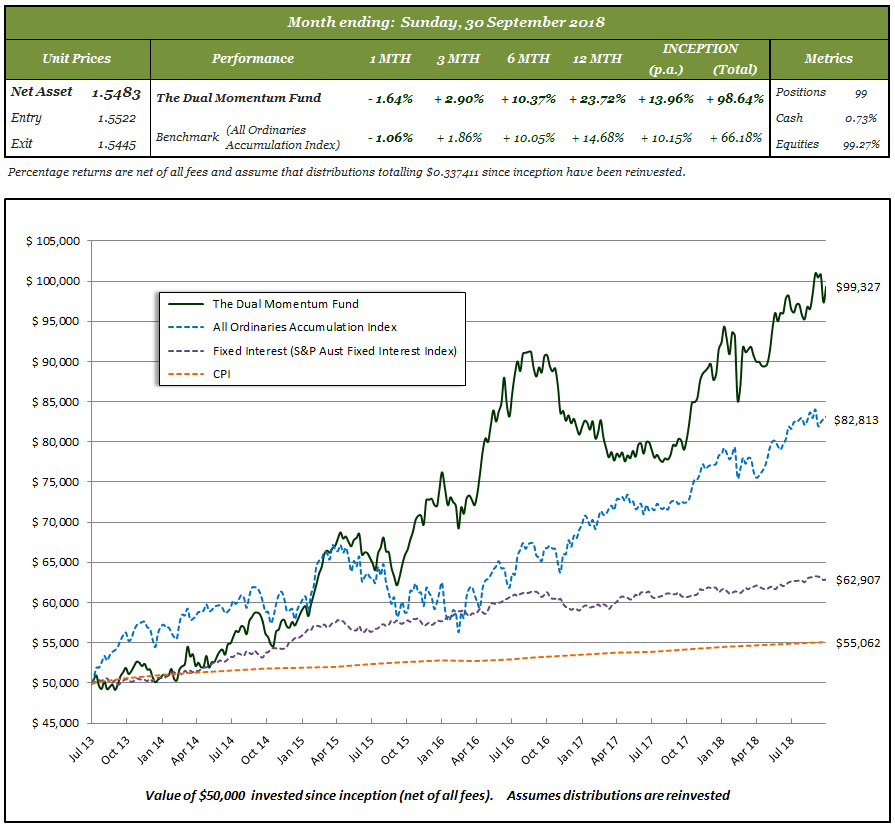
After some periods of pretty volatile action in both stocks and currencies the Fund returned -1.64% for September, bringing returns since inception to a still very healthy +98.64% or +13.96% per annum.
The USA (Nasdaq) gave up its position as the strongest market of recent times and turned in its first negative return for 6 months, posting -0.78% for September. Overall market returns were fairly muted over the month with small positive and negative net returns across the board, apart from Japan which posted a strong +5.49% for the month and is now the only one of our markets to have posted positive returns for each of the last 3 months. On further investigation it’s apparent that there have been periods of significant profit taking in the strongest stocks and our own portfolio has begun to rotate out of some of these positions and into stocks which are at earlier stages in their trend development. Experience suggests however that if and as this profit taking pattern continues there will be fewer emerging opportunities to replace our closed positions and that our protective allocation to cash is likely to rise. At month end Singapore, Hong Kong and Germany remain too soft to allow new investment and our exposure to these markets now stands at just 1.52%. Our allocation to the currently strongest markets of the USA and Japan stands at 92.0%. These stronger markets continue to provide the greatest number of investment opportunities for us, enabling the portfolio to remain virtually fully invested despite continuing softness in a number of global markets.
Despite some intra-month volatility, currency had only a small influence on our September results, with a portfolio-weighted contribution of just +0.22%.
Our proven strategy of systematically targeting stocks whose individual share price is both increasing and outperforming over medium to long term time frames will continue to be applied. Our active bottom-up investment style will guide portfolio allocations such that they will continue to expand or contract in response to market risk and reward characteristics as they evolve over time.